When you’re building your first MVP, you’ll inevitably face a critical decision: which development methodology should you use? The two most common approaches—Agile and Waterfall—represent fundamentally different philosophies about how software should be built. Choosing the wrong one can mean the difference between a successful launch and months of wasted effort.
For startups, this choice matters more than it does for established companies. You’re operating with limited resources, racing against time, and navigating uncertainty at every turn. The methodology you choose will shape how quickly you can adapt, how efficiently you spend your budget, and ultimately whether your MVP succeeds in validating your business idea.
In this guide, we’ll break down both approaches, compare them head-to-head, and give you a clear framework for deciding which methodology fits your startup MVP development needs. Spoiler alert: for most startups, one approach is clearly superior—but there are exceptions worth understanding.
Understanding Waterfall: The Traditional Approach
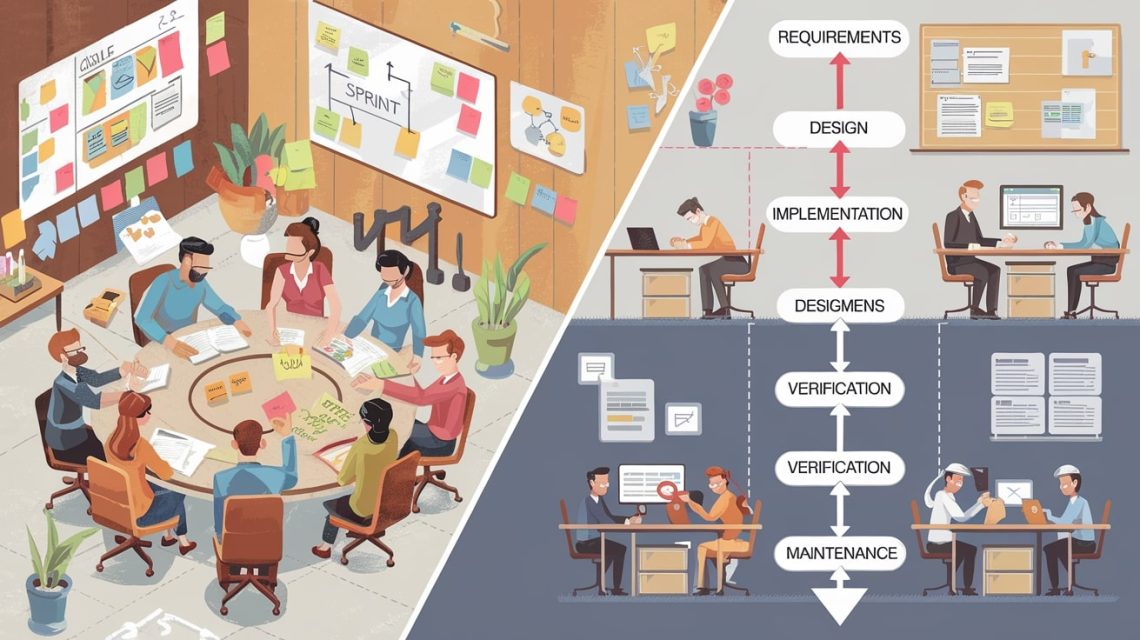
Waterfall is the older of the two methodologies, originating in manufacturing and construction before being adapted for software development in the 1970s. It’s called “Waterfall” because work flows sequentially downward through distinct phases, like water cascading down a series of steps.
The typical Waterfall phases are:
- Requirements: Gather and document all requirements upfront before any design or development begins.
- Design: Create detailed system architecture and design specifications based on the requirements.
- Implementation: Build the entire system according to the design documents.
- Testing: Test the complete system after development is finished.
- Deployment: Release the finished product to users.
- Maintenance: Fix bugs and make updates after launch.
Each phase must be completed before the next one begins. You don’t start coding until design is done. You don’t test until coding is complete. Changes to earlier phases require going back to the beginning and cascading updates through all subsequent phases.
According to Wikipedia, the Waterfall model was first formally described by Winston Royce in 1970, though ironically, Royce himself presented it as a flawed approach that invited failure.
When Waterfall Works
Waterfall isn’t inherently bad—it’s just designed for different contexts. It works well when:
- Requirements are well-understood and unlikely to change
- The technology is mature and predictable
- Regulatory compliance requires extensive documentation
- The project has a fixed scope, budget, and timeline
- Stakeholders need detailed plans before approving budgets
Think government contracts, embedded systems for medical devices, or large enterprise software with stable requirements. These projects benefit from Waterfall’s emphasis on planning and documentation.
Understanding Agile: The Iterative Revolution
Agile emerged in the early 2000s as a response to Waterfall’s rigidity. The Agile Manifesto, published in 2001, established four core values that prioritize flexibility and collaboration over process and documentation.
Unlike Waterfall’s sequential phases, Agile development happens in short cycles called “sprints” or “iterations,” typically lasting 1-4 weeks. Each sprint delivers a working piece of software that can be tested, demonstrated, and refined based on feedback.
Key characteristics of Agile include:
- Iterative development: Build in small increments, not one big release.
- Continuous feedback: Get user and stakeholder input throughout the process.
- Adaptive planning: Adjust priorities and scope based on what you learn.
- Cross-functional teams: Developers, designers, and product owners work together daily.
- Working software over documentation: Prioritize functional code over detailed specs.
Popular Agile frameworks include Scrum (with its sprints, standups, and retrospectives), Kanban (with its visual workflow boards), and Lean (with its focus on eliminating waste). Most startups adopt a hybrid approach, taking elements from multiple frameworks.
Agile vs Waterfall: Head-to-Head Comparison for MVPs
Let’s compare these methodologies across the dimensions that matter most for startup MVP development:
Handling Uncertainty
Waterfall: Assumes you know what you’re building from the start. Changes are expensive and disruptive.
Agile: Embraces uncertainty. Expects requirements to evolve and builds processes to accommodate change.
Winner for MVPs: Agile. The entire point of an MVP is to test assumptions and learn from users. You don’t know what you’re building until you’ve validated it—which makes Waterfall’s upfront planning counterproductive.
Speed to Market
Waterfall: Long development cycle before any working software exists. Users see nothing until the end.
Agile: Delivers working software in weeks, not months. Users can test real functionality early.
Winner for MVPs: Agile. As we covered in our MVP development timeline guide, getting to market quickly is essential. Agile’s iterative approach gets functional software in front of users faster.
Cost Efficiency
Waterfall: Expensive to change direction after requirements are locked. Discovering problems late in the process means rework.
Agile: Cheaper to pivot because you’re never too deep into a feature before validating it. Problems are caught early when they’re inexpensive to fix.
Winner for MVPs: Agile. Startups can’t afford to build the wrong thing. Agile’s continuous feedback loops prevent costly mistakes.
Documentation and Planning
Waterfall: Full documentation created upfront. Clear project plans and specifications.
Agile: Minimal documentation. Plans are adaptive and often informal.
Winner for MVPs: Depends. Most startups benefit from Agile’s lighter documentation. However, if you’re raising funding or working with enterprise clients, some documentation may be necessary. The key is finding the right balance.
Team Collaboration
Waterfall: Handoffs between specialized teams. Limited collaboration across phases.
Agile: Continuous collaboration. Cross-functional teams work together throughout the project.
Winner for MVPs: Agile. Startup teams are small and need to communicate constantly. Agile’s collaborative structure fits naturally with how startups operate.
Why Agile Wins for Most Startup MVPs
The verdict is clear: Agile is the better methodology for startup MVP development in almost all cases. Here’s why the match is so strong:
MVPs Are About Learning, Not Building
The purpose of an MVP isn’t to build a complete product—it’s to validate hypotheses about your market, users, and solution. This requires constant experimentation and adaptation. Agile’s iterative cycles are designed exactly for this kind of learning.
Waterfall assumes you know what success looks like before you start. But as we discussed in our article on common MVP development mistakes, one of the biggest errors founders make is assuming they understand user needs before testing them.
Startups Operate in Uncertainty
Your market might shift. Your users might want something different than you expected. A competitor might launch a feature that changes your priorities. Agile gives you the flexibility to respond to these changes without derailing your entire project.
Waterfall locks you into decisions made at the beginning when you had the least information. By the time you realize something is wrong, you’ve already invested months of development.
Resources Are Limited
Startups don’t have the luxury of extensive upfront planning. Every week spent on requirements documentation is a week not spent learning from real users. Agile’s “just enough” approach to planning conserves resources for what matters: building and testing.
Feedback Is Your Competitive Advantage
Established companies have brand recognition and customer loyalty. Startups compete by being faster and more responsive. Agile’s emphasis on continuous user feedback turns your size into an advantage—you can adapt faster than anyone else.
When Waterfall Might Still Make Sense
Despite Agile’s advantages, there are rare scenarios where Waterfall elements might be appropriate for startup MVP development:
Fixed-Scope Contracts
If you’re building an MVP for a client who requires a fixed price and scope, you may need more upfront planning than pure Agile allows. Consider a hybrid approach that combines Waterfall’s planning phases with Agile’s development sprints.
Highly Regulated Industries
Healthcare, finance, and other regulated industries sometimes require extensive documentation for compliance. You can still use Agile for development while layering on the documentation Waterfall provides.
Hardware-Software Integration
If your MVP involves physical hardware, the hardware development often follows a more Waterfall-like process. Software teams can still use Agile while coordinating with hardware timelines.
Outsourced Development with Limited Communication
Agile requires frequent communication between stakeholders and developers. If you’re working with an offshore team with significant timezone differences and limited availability, a more structured Waterfall approach might reduce coordination overhead.
That said, even in these scenarios, most teams adopt hybrid approaches that incorporate Agile principles wherever possible. Pure Waterfall is increasingly rare, even in traditional enterprises.
Implementing Agile for Your MVP: Practical Tips
Ready to adopt Agile for your startup MVP development? Here’s how to implement it effectively:
Start with Two-Week Sprints
Two weeks is the sweet spot for most startups. It’s long enough to accomplish meaningful work but short enough to course-correct quickly. Each sprint should end with a demo of working features and a retrospective to improve your process.
Prioritize Ruthlessly
Agile only works if you’re willing to say “not yet” to most features. Use frameworks like MoSCoW or RICE scoring to decide what goes into each sprint. Your backlog will always be longer than your capacity—that’s normal.
Embrace “Good Enough”
The goal isn’t perfection; it’s learning. Ship features that are good enough to test your hypotheses, then iterate based on feedback. Perfectionism is the enemy of progress in Agile MVP development.
Communicate Daily
Even if you’re a solo founder, hold yourself accountable with daily check-ins. What did you accomplish yesterday? What will you do today? What’s blocking you? This simple practice maintains momentum and surfaces problems early.
Measure What Matters
Define success metrics for each sprint. Are you measuring user signups? Engagement rates? Revenue? Agile without measurement is just fast iteration toward unclear goals. Let data drive your decisions.
If you’re looking for professional help implementing Agile MVP development, consider working with a specialized MVP developer who understands lean startup principles.
Common Agile Mistakes to Avoid
Agile isn’t a magic solution. Here are pitfalls that can undermine your MVP development:
Agile in Name Only
Some teams claim to be Agile but still operate like Waterfall—long planning sessions, infrequent releases, resistance to change. True Agile requires cultural buy-in, not just process changes.
Skipping Retrospectives
Retrospectives are where you improve your process. Skipping them means you’re not learning from your mistakes. Even a 15-minute reflection at the end of each sprint can dramatically improve your next one.
No Definition of Done
Without clear criteria for when a feature is “done,” work drags on indefinitely. Define what done means for your team—tested, reviewed, deployed—and stick to it.
Ignoring Technical Debt
The pressure to ship fast can lead to shortcuts that accumulate as technical debt. Build time into each sprint to address debt before it becomes crippling. A little maintenance now prevents major problems later.
Over-Engineering the Process
Agile frameworks like Scrum come with many roles (Scrum Master, Product Owner) and ceremonies (sprint planning, grooming, demos, retrospectives). For a small startup, you don’t need all of this. Take what works and leave the rest.
Conclusion: Choose Agile, But Make It Your Own
For startup MVP development, Agile is almost always the right choice. Its emphasis on iteration, feedback, and adaptability aligns perfectly with the uncertainty and resource constraints startups face. Waterfall’s rigid phases and upfront planning simply don’t fit the reality of building something new.
But don’t treat Agile as a religion. The best startups take Agile principles—continuous delivery, user feedback, adaptive planning—and adapt them to their specific context. You might run weekly sprints instead of two-week sprints. You might skip formal sprint planning in favor of quick morning syncs. You might add documentation where it genuinely helps.
The goal isn’t Agile purity. The goal is building an MVP that validates your business idea quickly and efficiently. Use whatever approach gets you there fastest—and for most startups, that approach will be Agile.
Have questions about choosing a development methodology for your MVP? Drop a comment below—we read and respond to every one.